How to Track Client Outcomes Without Spreadsheets
Tracking client outcomes gives mental health organizations a clearer picture of how care is working. It helps clinical teams understand whether clients are improving, gives clinicians information to adjust treatment in real time, and provides leadership with data to make informed decisions about programs, resources, and care quality. Done well, it serves as foundation of a high-performing and continuously improving clinical organization.
The challenge is that effective measurement requires the right infrastructure. Spreadsheets, paper forms, Google Forms, and manual data entry may be manageable with a small number of clients, but they quickly become difficult to sustain as an organization grows. The result is more manual work for clinicians and administrators who are already stretched thin, making it harder to consistently collect, interpret, and act on outcomes data.
That’s where tech-enabled Measurement-Based Care comes in.
What Is Measurement-Based Care?
Measurement-Based Care (MBC) is the systematic, ongoing collection of client-reported outcome data to inform treatment decisions. Rather than relying on clinical intuition alone, MBC gives clinicians a structured, evidence-based view of how each client is responding to care over time.
The core of MBC is simple, with clients regularly completing validated assessment tools (like the PHQ-9 for depression or the GAD-7 for anxiety) and their clinician reviewing those results in order to guide session discussions and treatment decisions. When scores are improving, the approach is working. When they are not, it is a signal to adjust.
Research consistently shows that MBC improves outcomes. A review published in the Journal of Counseling Psychology found that therapists who reviewed client data before sessions saw clients improve 2.6 times faster than those who reviewed it after. Clients who complete assessments regularly are more likely to stay engaged in care, more likely to experience symptom improvement, and less likely to deteriorate without the care team noticing.
That’s why, for many organizations, the challenge isn’t recognizing the value of measurement. It’s making it work across teams, workflows, and client populations.
Challenges with Manual Tracking
When outcome measurement depends on paper forms, manual scoring, and spreadsheets, a few things tend to happen.
- Completion rates become inconsistent because the process relies on individual clinicians remembering to administer assessments.
- Scoring takes time and introduces error.
- Data lives in multiple places and has to be compiled manually before it can tell you anything meaningful.
- And by the time a trend becomes visible, the clinical moment to respond has often already passed.
The result is that outcome measurement becomes an administrative exercise rather than a clinical one. The data exists, but it is not informing care in the way it should.
What Consistent MBC Looks Like in Practice
Effective outcome tracking shares a few characteristics regardless of the setting or population.
It is automated: Assessment delivery should not depend on a clinician handing a form to a client. When assessments go directly to clients via email or SMS on a set schedule, completion rates improve significantly and the process stops consuming clinical time.
It is immediate: Results should be scored and available the moment a client submits, not after someone enters data into a spreadsheet. Clinicians should be able to walk into a session knowing exactly where their client is today, relative to where they were two weeks ago.
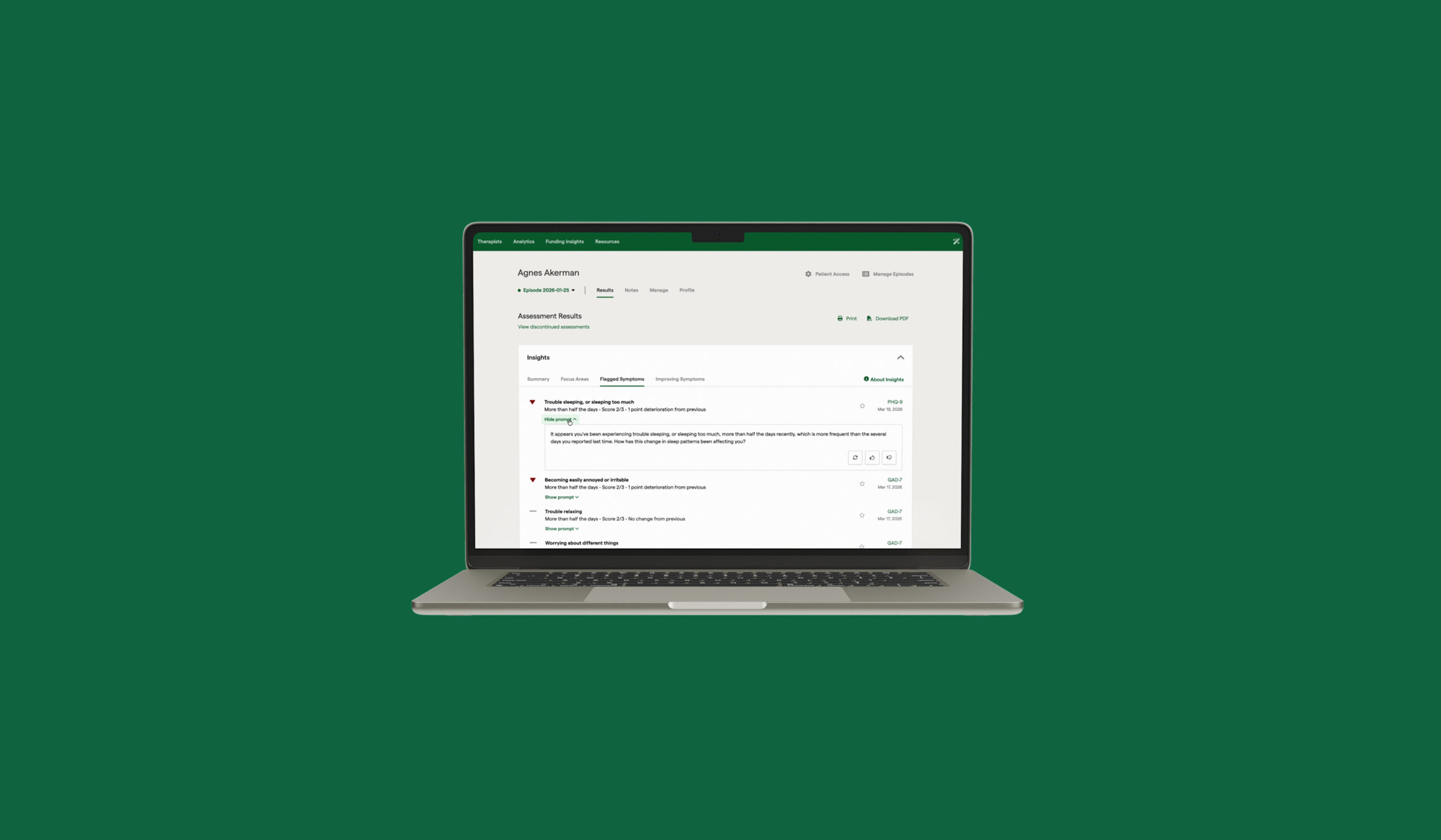
It surfaces risk proactively: Rather than relying on a clinician to notice a trend, the system should flag clients who are not improving or who show elevated risk, so care teams can respond before a situation escalates.
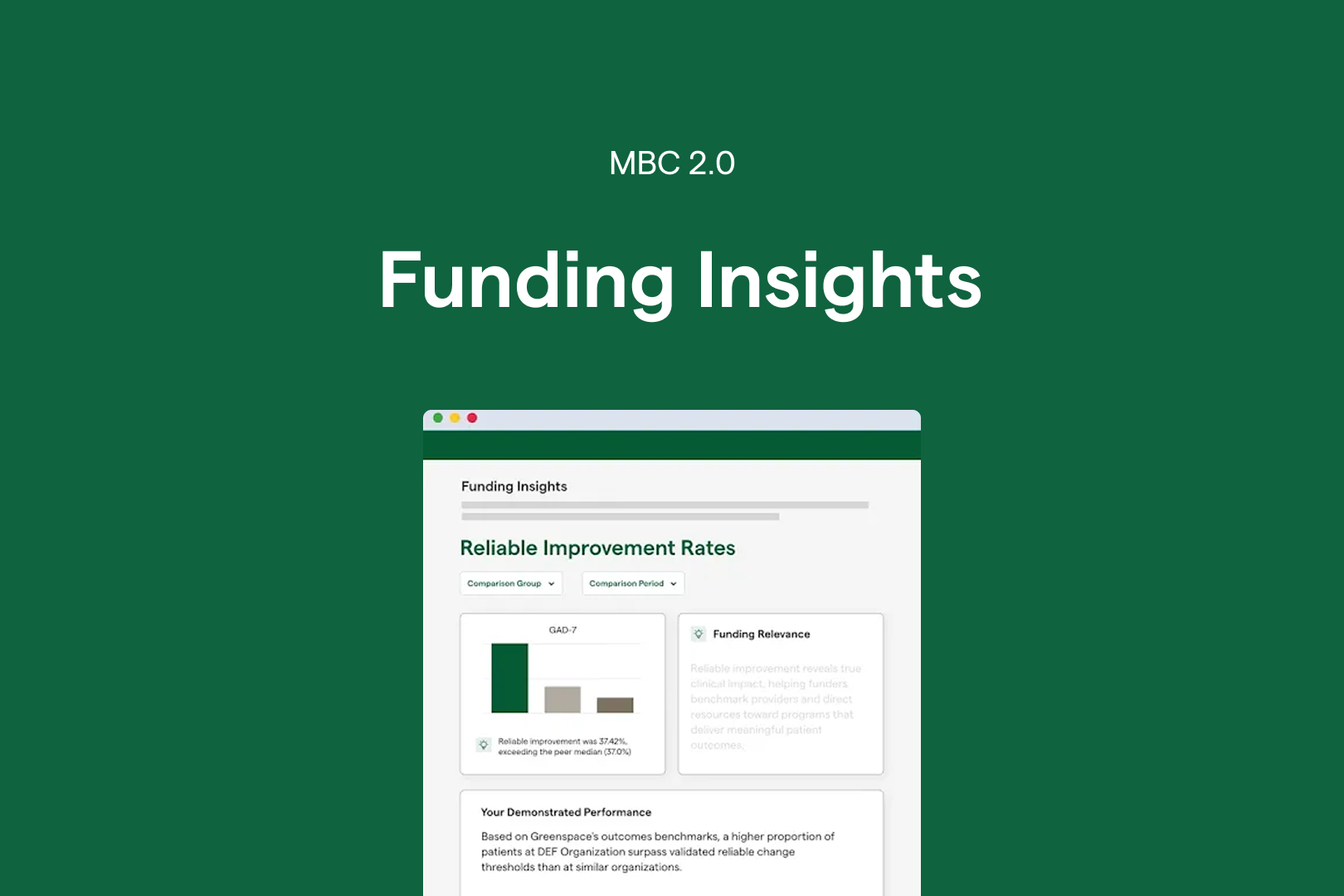
It connects individual data to the bigger picture: Program leaders should be able to see aggregate outcomes across their full caseload without compiling anything manually. The same data that informs individual sessions should also be informing organizational decisions about programs, staffing, and care quality.
It fits into existing workflows: The best MBC implementations are ones where measurement feels like a natural part of care, not an additional burden. When data lives in the same system clinicians are already using, it gets reviewed. When it requires logging into a separate tool or consulting a spreadsheet, it often does not.
How Greenspace Supports Outcome Tracking
Greenspace is built to make MBC practical and sustainable for mental health organizations. The platform facilitates the complete measurement workflow, from assessment delivery through clinical review and organization-wide reporting, so that tracking outcomes does not require manual effort from clinicians or administrators.
When a client is enrolled, their assessment schedule is assigned automatically based on program, diagnosis, or care pathway. Assessments are delivered to clients on schedule via email, SMS, or kiosk. Results are scored instantly, visualized in a clinical dashboard, and risk flags surface in real time. Clinicians can see a client’s full symptom trajectory before a session, and clinical leaders can monitor outcomes across every program and site from a single view.
For organizations using an EHR, Greenspace integrates directly so results sync back into the patient record without any added steps. This means assessments are automatically assigned based on EHR data, and clinicians can review assessment results directly from the client chart to inform sessions and treatment decisions.
IWK Health is one example of what this transition looks like. Before Greenspace, clinicians relied on paper-and-pencil measures, manually scoring assessments and building their own spreadsheets to track progress. Practices varied significantly across teams. Moving to Greenspace allowed them to standardize measurement across the organization, reduce the administrative load on clinicians, and make outcome conversations a consistent part of everyday care.
Getting Started
Implementing MBC does not require a complete overhaul of how your organization operates. The most successful implementations start with a clear goal, a defined set of measures, and a system that makes the process as easy as possible for clinicians and clients alike.
If your organization is currently tracking outcomes in spreadsheets or on paper, book a demo to see how MBC can streamline operations, increase data-informed decision-making, and improve clinical outcomes.