How to Track Progress in Clinical Therapy
Imagine if you could walk into your next client session equipped with the knowledge of how their symptoms have changed since you first met, where they’re making meaningful progress, and where they may be struggling. Not just based on what you remember from your last conversation, but on a clear picture of how their symptoms and well-being have changed throughout treatment.
That is what tracking clinical progress makes possible. By regularly collecting brief, patient-reported measures, they give you and your client a shared picture of where treatment started, how things are changing over time, and what may be worth exploring next. The data works to support and compliment your clinical judgment, giving you a new way to visualize progress, and a place to start each session with your client.
This guide walks through how to track clinical progress in therapy in a way that is practical, clinically meaningful, and sustainable across a full caseload.
Understanding Why Progress Tracking Matters
Measurement-Based Care (MBC) is the practice of regularly collecting patient-reported outcomes (PROMs) and using it to inform treatment. The core idea is that, alongside what you observe and what your client shares, you have a regular, consistent signal of how they are experiencing treatment.
For clinicians, the value shows up in a few ways:
1. Earlier detection of change
Change is not always easy to notice from session to session, for clinicians or clients. Regular measurement can help bring gradual shifts, in either direction, into view sooner, and can flag clients who may need additional support before symptoms escalate.
In a well-known study of 550 clients, Hannan and colleagues (2005) asked therapists to predict which clients would deteriorate. Forty did, and therapists anticipated one of them, while a statistical algorithm based on clients’ own questionnaire responses flagged 36 of the 40.
The takeaway is not that clinicians are missing something they should see. It is that a consistent, objective signal can catch what is genuinely difficult to detect any other way, and flag clients who may need additional support before symptoms escalate.
2. More productive sessions
Scores can offer a natural starting point for conversation, helping you and your client focus on the themes that matter most to them.
3. A stronger therapeutic relationship
When clients can see their own progress and discuss it with you, measurement becomes collaborative rather than something done to them. Including a therapeutic alliance measure also gives you regular feedback on how the work is landing.
4. Better-informed treatment decisions
Knowing whether a client is on track helps you decide when to stay the course, adjust, or consider a different approach.
A review published in JAMA Psychiatry by Lewis and colleagues (2019) examined the evidence across 21 randomized controlled trials and concluded that MBC enhances usual care by expediting improvement and by rapidly detecting patients whose health would otherwise deteriorate. The authors noted that at least nine review articles have found MBC outperforms usual care, with benefits across settings, populations, and disorders.
5. Insight you might not otherwise have
Many clinicians find that routine measurement teaches them things about their clients that did not come up in conversation. Even when a score does not match your clinical impression, that gap can be a valuable prompt to explore what the client is experiencing.
6. Engagement that supports attendance
Measurement is also associated with stronger client engagement in care, which can help reduce no-shows and cancellations.
Measurement-Based Care with Greenspace
Want to see what tracking progress with Measurement-Based Care can look like at your organization?
Book a ConsultationHow to Effectively Monitor Clinical Outcomes and Progress
None of this replaces clinical judgment. The evidence supports MBC as a practical way to see trajectories earlier and to support the conversation between you and your client, and it points to the importance of making measurement a genuine part of clinical care. That is the focus of the steps below. The goal is to add another perspective that supports the expertise you already bring to the work.
Step 1: Choosing Measures
Tracking progress starts with deciding what to measure. Clinicians often choose to combine a few types of measures to get a complete picture.
- Symptom measures: Validated tools like the PHQ-9 for depression and the GAD-7 for anxiety are widely used because they are brief, well studied, and easy for clients to complete. Depending on your population, you may also use measures for trauma, substance use, sleep, or other presenting concerns.
- Functioning and quality of life: Symptoms are only part of the picture. Measures of day-to-day functioning and quality of life capture whether a client is actually living differently, which is often what they came to therapy for in the first place.
- Therapeutic alliance: The quality of the working relationship is one of the most consistent predictors of outcomes. Brief alliance measures, completed regularly, give you early feedback on how the therapeutic relationship is landing for the client.
- Individualized goals: Standardized measures tell you how a client compares to established ranges. Individualized approaches, such as tracking progress toward a client’s own goals, capture what matters most to that specific person.
Greenspace offers a library of more than 550 validated assessments, and protocol customization lets your organization configure which measures are used for which programs, populations, or care pathways.
Step 2: Capture a Baseline Early
Progress only means something when you can compare it to a starting point. The first assessment, ideally completed before or at the first session, gives you a baseline for symptom severity, functioning, and where the client sits relative to clinical ranges.
A baseline also shapes how you interpret everything that follows. A client who starts in the severe range and moves to moderate has made meaningful progress even though they have not yet reached remission. A client who starts in the mild range may have less room to move on the same measure. Without a baseline, it can be hard to identify when meaningful progress has been made.
With Greenspace, assessments can be assigned automatically at intake based on a client’s program, diagnosis, or care pathway.
Step 3: Decide How Often to Measure
Determining the right cadence is a balance. Measure too rarely and you miss the window to respond. Measure too often and you risk fatigue, which lowers completion and reduces the value of the data.
Many clinicians and programs settle on measuring before each session or at a regular interval such as every two weeks, then adjust based on the measure and the client. Some measures are designed for session-by-session use, while others are better suited to less frequent check-ins.
What matters most is consistency. A steady cadence produces a trend line you can read, and trends are far more informative than any single score. Greenspace lets your organization set assessment schedules by program or care pathway and delivers assessments automatically on that schedule, keeping a steady cadence without adding to your workload.
Step 4: Make Completion Easy for Clients
Progress tracking only works if clients actually complete the measures they’re assigned. The most common reasons they do not is friction when assessments feel like extra homework, are difficult to complete, or aren’t being used and discussed in sessions.
A few things make completion more likely:
- Send assessments automatically by email or SMS, on a set schedule, so clients can complete them on their own time before a session.
- Offer in-clinic options, such as a kiosk, for clients who prefer to complete measures on site.
- Explain the why. Clients are more likely to complete measures when they understand how the results will be used. A short explanation at intake goes a long way.
- Use the results in session. This is the strongest driver of ongoing engagement. When clients see that their responses are being read and discussed, they understand the importance of completing measures.
Step 5: Learn to Read the Data
Collecting measures is only the beginning. The real impact of MBC lies in interpreting the results and using them to inform the course of treatment. A few concepts help you distinguish real clinical change from normal variation.
Clinical ranges and severity. Published scoring bands give a first read on where a client sits. For example, PHQ-9 scores are commonly grouped from minimal to severe, and a total of 10 or higher is a widely used threshold for clinically significant depression symptoms. The GAD-7 is interpreted in a similar way for anxiety. Knowing whether a client has crossed into or out of the clinical range is often more informative than the raw number alone.
Reliable change. Scores fluctuate from week to week for reasons that have nothing to do with treatment. Reliable change indicators help you tell whether a shift is large enough to be more than measurement noise.
Direction over time. One score is a snapshot. Several scores form a trajectory. Looking at whether a client is improving, plateauing, or worsening across multiple time points is far more useful than any single data point.
Expected progress. Perhaps the most clinically useful question is not “has the score gone down?” but “is this client progressing the way we would expect for someone with a similar presentation?” A client who is improving slowly but still tracking below the expected trajectory may need a different conversation than one who is on track.
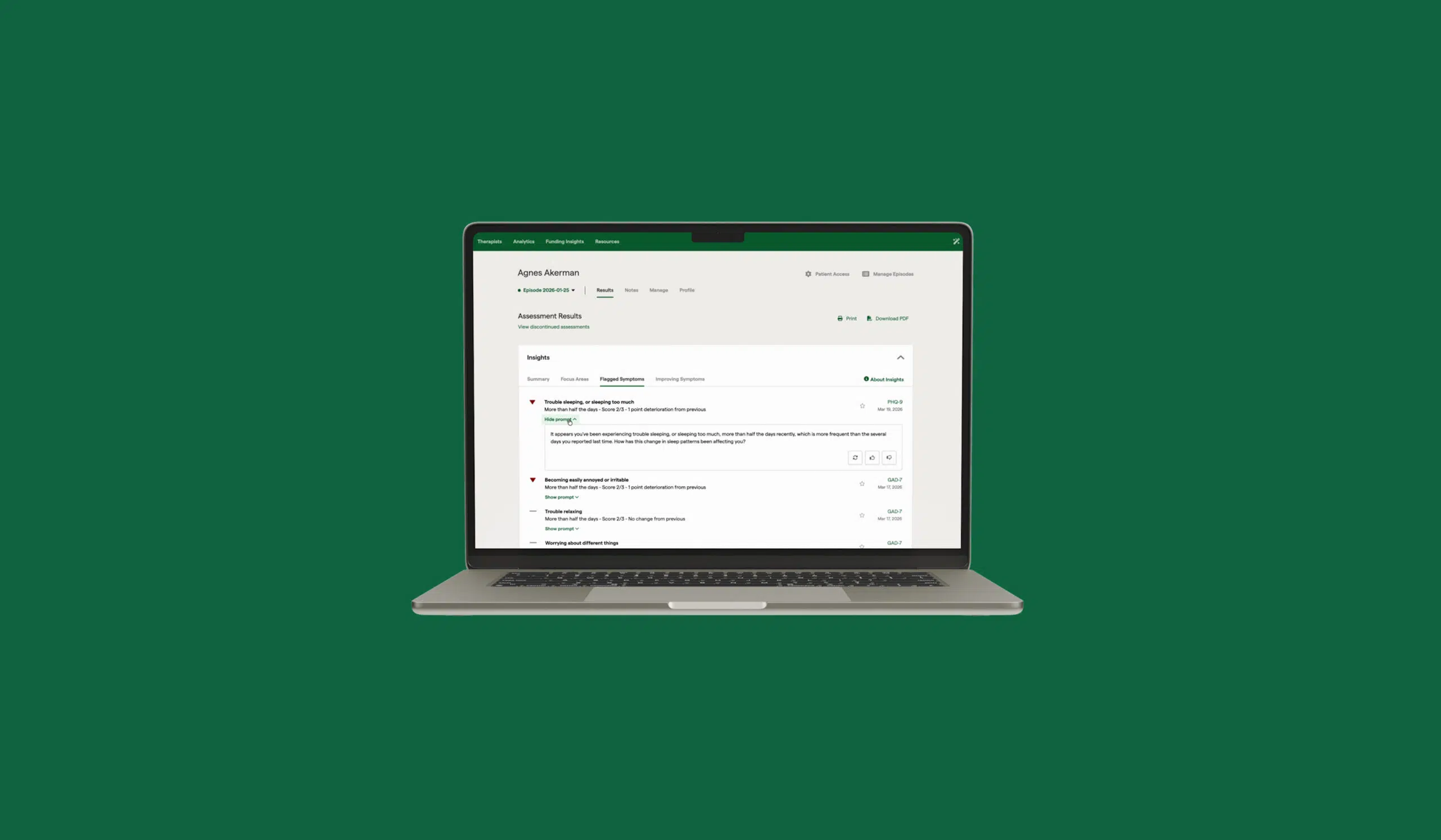
Greenspace brings these pieces together visually for clinicians, supervisors, and clients. Results appear in a clinical dashboard with severity bands, change over time, and plain-language insights, so the numbers come with context. The expected progress feature shows whether a client is tracking in line with anticipated recovery trajectories, which helps you spot clients who are falling behind earlier.
It is also worth remembering that scores and clinical impressions will not always line up. A client may report more distress than you observed in the room, or less. Rather than a problem, that discrepancy is often useful information, and a good reason to ask the client what the number is capturing for them. MBC is designed to support your clinical expertise, not override it.
If you want to build confidence interpreting results, Greenspace offers resources for clinicians, including the Yale MBC Collaborative Knowledge Hub, which brings together videos, articles, research, and implementation strategies developed with expert psychologists.
Step 6: Bring the Results Into the Session
Tracking progress only benefits care if the information makes it into the room. Reviewing results before a session, even briefly, lets you walk in knowing how the client has been doing since you last met, rather than finding out in the first ten minutes.
Then comes the conversation itself. Bringing scores into session does not have to feel clinical or procedural. A few approaches that tend to work well:
- Start with curiosity, not interpretation. “I noticed your sleep score has been creeping up over the past few weeks. What do you make of that?” invites reflection rather than putting the client on the spot.
- Share the trend, not just the number. Looking at a graph together makes progress, or the lack of it, concrete and gives you both something to respond to.
- Celebrate movement. When a client has made real progress, point it out. Visible improvement can be motivating, especially in the middle of treatment when it is easy to lose sight of how far someone has come.
- Use a plateau as an opening. If progress has stalled, the data gives you a natural, non-blaming way to ask what might need to change.
Greenspace’s session prompts support this by translating the results a client has just completed into suggested talking points you can use to open the session. This is especially helpful for clinicians who are newer to MBC and building the habit of working with data in the room.
Step 7: Catch Off-Track Clients Early
With a full caseload, it may not be realistic to deeply review every client’s data before every session. This is where it helps to have the system do some of the surfacing.
The goal is to identify, at a glance, who needs attention:
- Clients who are not improving as expected
- Clients who have worsened
- Clients who show elevated risk
- Clients who have not completed a recent assessment.
Catching these cases early is one of the most valuable things progress tracking offers. A client who is deteriorating quietly is far easier to help when you notice in week three than in week ten. Because gradual worsening is hard to spot from session to session, a consistent signal can make a real difference here.
Greenspace’s Caseload Assistant gives you a prioritized view of your caseload, flagging clients who are off track or who may need immediate attention, and notifying you when risks arise. Configurable clinical alerts also notify you when assessment responses indicate elevated risk, such as suicidal ideation or severe symptom scores, and they appear directly in your clinician dashboard so you can prioritize follow-up or adjust a care plan.
Step 8: Share Progress With Clients
MBC works best when clients can see their progress. When clients can see their own data, they become more active participants in their care. Seeing a graph of their symptoms over time can validate that effort is paying off, make setbacks feel less daunting, and give them something concrete to bring to the next conversation.
Greenspace’s client visibility tools let clients view their own results and progress between sessions, so they can come prepared to discuss what they are noticing, and they give the two of you a shared reference point for decision-making about next steps in treatment. For many clients, this changes how they relate to treatment, from something that happens to them to something they are tracking and shaping alongside you.
Step 9: Use MBC Data in Supervision and Documentation
MBC data is also valuable beyond the individual session. In supervision, outcome data gives supervisors and clinicians a shared, objective reference point for discussing cases, particularly those that are not progressing as expected. It shifts the conversation from impressions to evidence.
For documentation, referencing recent assessment results in treatment plans and progress notes connects your clinical reasoning to measurable information. That strengthens the record and supports continuity of care when multiple providers are involved.
When Greenspace is integrated with your EHR, assessment results sync back into the client record automatically, so this information is available where you already document and you are not duplicating work between systems.
Putting It All Together
Tracking clinical progress in therapy comes down to a simple workflow. Choose measures that fit your client, capture a baseline, measure at a steady cadence, make completion easy, read the data in context, bring it into the session, and act on what it shows. Done consistently, that workflow helps you see change earlier, respond sooner, and give clients a clearer view of their own progress.
Greenspace is built to make your workflow easier to sustain. Assessments are assigned and delivered automatically, results are scored instantly and visualized in a clinical dashboard, and features are designed to help you interpret and act on what you see, surface the clients who need attention, and bring clients into the process.
Interested in seeing how Greenspace can support progress tracking in your practice? Book a demo or reach out at info@greenspacehealth.com.
References
de Jong, K., Conijn, J. M., Gallagher, R. A. V., Reshetnikova, A. S., Heij, M., & Lutz, M. C. (2021). Using progress feedback to improve outcomes and reduce drop-out, treatment duration, and deterioration: A multilevel meta-analysis. Clinical psychology review, 85, 102002. https://doi.org/10.1016/j.cpr.2021.102002
Hannan, C., Lambert, M. J., Harmon, C., Nielsen, S. L., Smart, D. W., Shimokawa, K., & Sutton, S. W. (2005). A lab test and algorithms for identifying clients at risk for treatment failure. Journal of clinical psychology, 61(2), 155–163. https://doi.org/10.1002/jclp.20108
Jensen-Doss, A., Haimes, E.M.B., Smith, A.M. et al. Monitoring Treatment Progress and Providing Feedback is Viewed Favorably but Rarely Used in Practice. Adm Policy Ment Health 45, 48–61 (2018). https://doi.org/10.1007/s10488-016-0763-0
Lewis, C. C., Boyd, M., Puspitasari, A., Navarro, E., Howard, J., Kassab, H., Hoffman, M., Scott, K., Lyon, A., Douglas, S., Simon, G., & Kroenke, K. (2019). Implementing Measurement-Based Care in Behavioral Health: A Review. JAMA psychiatry, 76(3), 324–335. https://doi.org/10.1001/jamapsychiatry.2018.3329