Ontario’s mental health and addictions sector is moving toward a more standardized approach to data collection and reporting.
Through the Mental Health and Addictions Provincial Data Set (MHA PDS), Ontario Health is establishing consistent, client-level data collection across community and outpatient mental health and addictions services. The goal is to create a clearer picture of who is accessing care, how services are being used, and how clients move through the system, giving providers and system leaders better information to support planning and improve service delivery.
For adult community and outpatient mental health and addictions providers funded by the Ministry of Health or Ontario Health, participation is becoming a provincial requirement. Organizations are expected to be compliant with an approved data-submission approach by December 10, 2026.
For addictions providers, one important component of standardized assessment is the Admission and Discharge Criteria and Assessment Tools (ADAT) package developed by the Centre for Addiction and Mental Health (CAMH). ADAT is designed to help clinicians assess client needs and determine the appropriate level and intensity of care.
What assessments are included in ADAT?
The ADAT package brings together eight assessment tools that capture different aspects of a client’s substance use, readiness for treatment, health, social support, symptoms, and overall functioning.
Drug History Questionnaire (DHQ) – Captures information about a client’s history and patterns of psychoactive substance use, helping clinicians build a clearer picture of current and past substance use.
Adverse Consequences of Substance Use (ACDU) – Explores the consequences a client has experienced in connection with substance use and the areas of their life that may be affected.
SOCRATES (Stages of Change Readiness and Treatment Eagerness Scale) – Assesses a client’s recognition of substance-related problems, ambivalence about change, and readiness to take steps toward recovery.
Treatment Entry Questionnaire (TEQ) – Explores factors related to a client’s entry into treatment, including their perceptions, circumstances, and motivation for seeking care.
Drug-Taking Confidence Questionnaire (DTCQ-8) – Measures a client’s confidence in their ability to resist alcohol or drug use across different high-risk situations.
BASIS-32 (Behavior and Symptom Identification Scale) – Provides a broader view of behavioural health symptoms and functioning across areas including depression and anxiety, relationships, daily living, and substance use.
Multidimensional Scale of Perceived Social Support (MSPSS) – Assesses a client’s perception of the social support available to them from family, friends, and significant others.
Health Screening Form (HSF) – Captures relevant physical health information that may affect assessment, treatment, or referral decisions.
The final component brings information from the eight assessments together into a Referral and Decision Tracking Summary, providing clinicians with a consolidated view to support treatment and referral decisions.
Collecting the assessments is only the first challenge
For providers, introducing this breadth of standardized assessment creates an immediate operational question: how do you collect all of this information consistently without adding significant administrative burden for clinicians and clients?
Some organizations may still rely on paper forms or manual processes, while others may be able to build the assessments directly into their EHR. But simply digitizing an assessment doesn’t necessarily make the resulting data easy to use.
With eight different assessments capturing different dimensions of a client’s experience, clinicians can quickly be faced with a significant volume of scores and information to interpret. They need to understand what has changed, where a client may be struggling, whether a result requires attention, and how different measures fit together to tell a broader story about the client’s progress and needs. Without the right approach in place to find meaning in the results, these measures can quickly become a mandatory checkbox with no clinical value.
With that, the question becomes less about where the assessments live and more about what you can do with the information once you have it.
That’s where purpose-built Measurement-Based Care technology paired with a sophisticated EHR integration becomes particularly valuable.
Bringing best-in-class MBC into the EMHware workflow
EMHware and Greenspace have partnered to bring advanced Measurement-Based Care capabilities directly into the EMHware workflow.
Greenspace is built specifically for the routine collection, interpretation, and use of behavioural health assessment data. Rather than simply capturing assessment scores, the platform helps turn that information into actionable clinical insights that clinicians can use throughout care.
Through the integration, client creation and updates can sync automatically between EMHware and Greenspace. Assessments can be delivered through multiple methods, including email, SMS, kiosk, QR code, and in-session completion, with automated scheduling and reminders helping organizations collect the right information at the right time.
Once assessments are completed, Greenspace gives clinicians much more than a collection of individual scores. Interactive results and longitudinal visualizations make it easier to understand progress over time, while clinical flags, trends, symptom-level information, and actionable insights can help surface the information most relevant to a client’s care.
And importantly, clinicians don’t have to leave EMHware to access it.
Advanced clinical insights, without leaving the EHR
The Greenspace MBC Overlay brings Greenspace functionality directly into EMHware through a browser extension, allowing clinicians to access key MBC workflows from the client record they already use every day.
From within EMHware, clinicians can trigger assessments, manage assessment and program assignments, review results and clinical insights, and archive clients. When deeper exploration is needed, they can launch directly into the client’s full interactive Greenspace results.
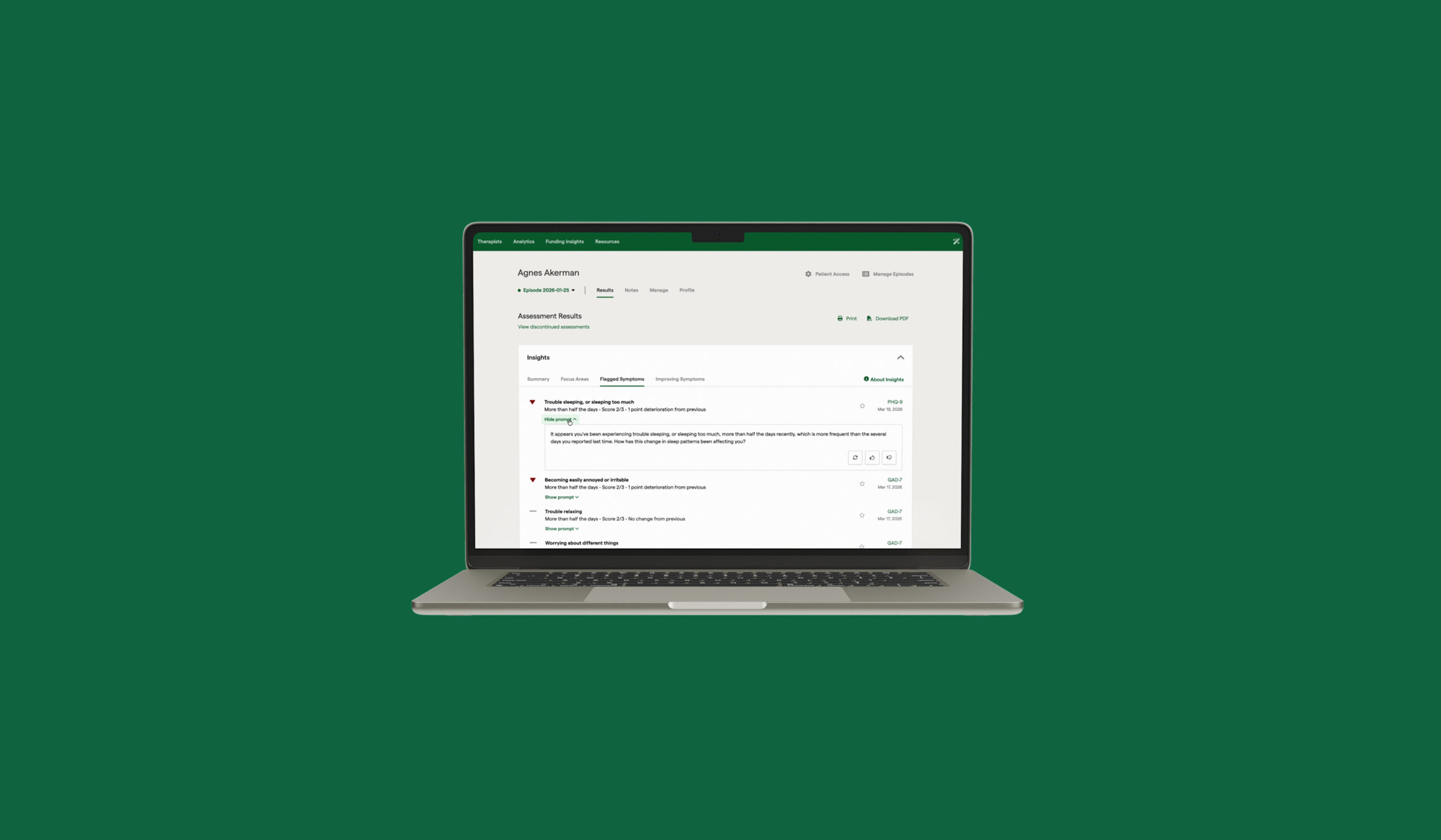
The overlay can also surface Greenspace Results Insights directly within EMHware. Rather than requiring a clinician to review every score individually, these insights can draw attention to meaningful information across a client’s assessment history, including reliable improvement or deterioration, emerging trends, and changes in therapeutic alliance.
This creates a workflow where EMHware remains the central system clinicians work from, while Greenspace provides the specialized MBC capabilities needed to make assessment data clinically useful.
Behind the scenes, the deeper integration can automate client setup and assessment workflows and populate results back into EMHware. At the point of care, the MBC Overlay gives clinicians immediate access to assessments, results, and insights without introducing another disconnected system into their day.
Turning eight assessments into one clinical story
The value of this approach becomes even more important when organizations are collecting a standardized battery like ADAT.
A clinician may have information about substance use history, consequences of use, treatment readiness, confidence in avoiding substance use, social support, physical health, symptoms, and functioning. Each measure provides useful information on its own, but reviewing them individually puts the responsibility on the clinician to bring all of those data points together.
A purpose-built MBC platform can help make that information easier to understand and act on.
Instead of asking clinicians to sift through scores across multiple forms, Greenspace can help surface meaningful changes, identify areas that may require attention, visualize progress over time, and provide a clearer picture of the client’s experience across assessments. The Referral and Decision Tracking Summary can then bring information from the full assessment battery together to support the standardized ADAT workflow.
The result is an approach that supports both sides of standardized assessment: collecting the required information consistently and making that information useful once it’s collected.
Building assessment into care, rather than around it
Ontario’s move toward more standardized mental health and addictions data presents an opportunity to think beyond compliance.
When organizations are required to collect more information, the technology supporting that process matters. Assessment data shouldn’t simply be completed, stored, and reported. It should help clinicians better understand the people they’re supporting and give organizations greater visibility into the impact of their services.
Together, EMHware and Greenspace provide the infrastructure to make that possible. EMHware provides the core EHR and case management workflow, while Greenspace adds purpose-built Measurement-Based Care technology for automated assessment delivery, advanced results and visualizations, clinical insights, symptom-level information, and organization-wide analytics.
And through the EMHware integration and Greenspace MBC Overlay, those capabilities can become part of the workflow clinicians are already using.
For organizations preparing to collect a growing volume of standardized assessment data, the goal shouldn’t just be to get the assessments completed. It’s to make every assessment more useful to the clinicians, clients, and organizations collecting them.
To learn more about how an EMHware and Greenspace integration can meet your organization’s measurement and reporting needs, book a call with an implementation expert today.