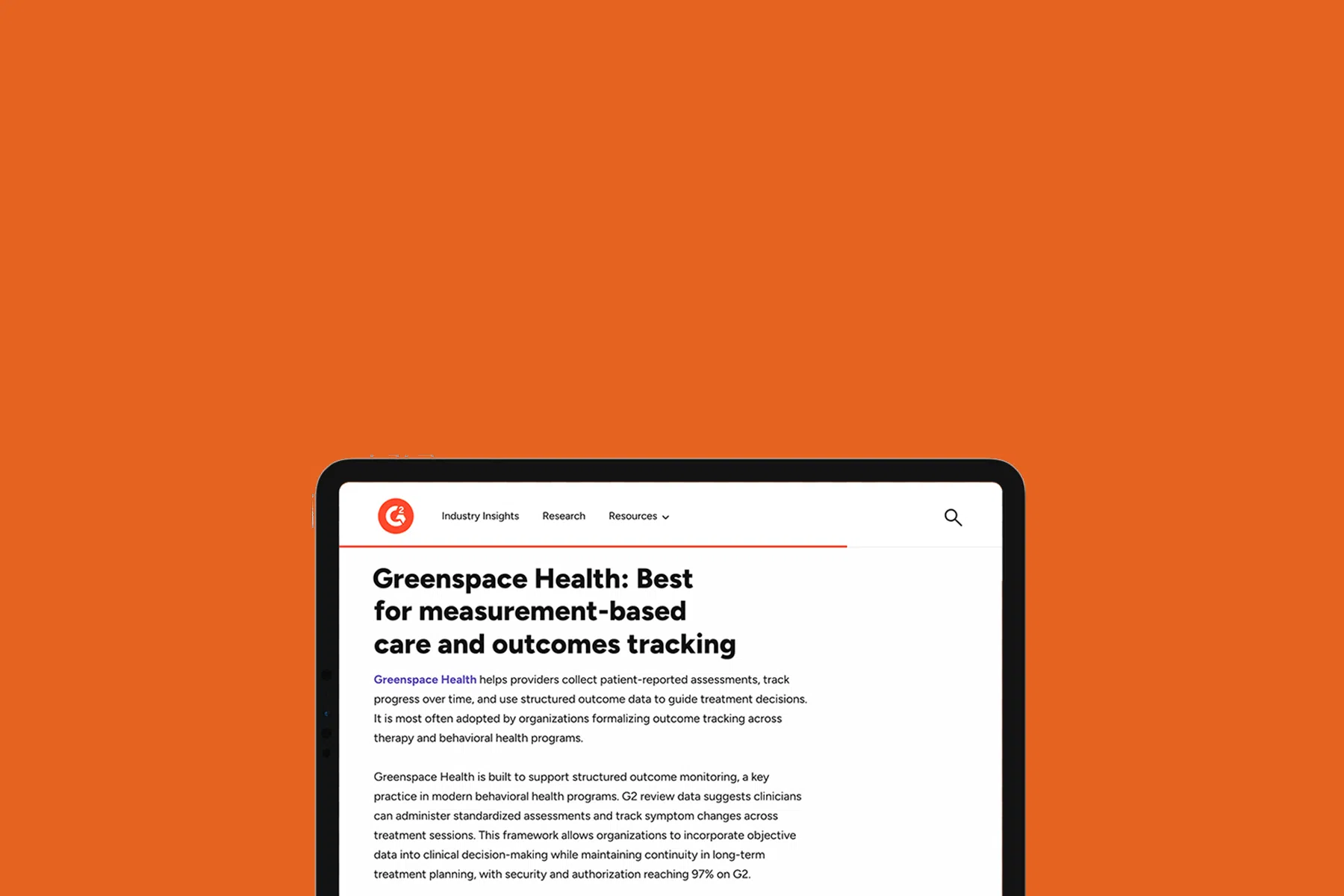
Greenspace was recently recognized by G2 as the Best Platform for Measurement-Based Care and Outcomes Tracking in its 2026 Mental Health Software rankings.
While we’re incredibly proud of this recognition, what stands out most isn’t where Greenspace ranked. It’s that Measurement-Based Care (MBC) was recognized at all.
Just a few years ago, most conversations about mental health technology focused on electronic health records, telehealth, scheduling, billing, or documentation. Outcome measurement was often viewed as a “nice-to-have” clinical initiative rather than a core operational requirement.
For years, MBC was championed primarily as a clinical best practice; something the research supported, something a few organizations were implementing, but not something the broader system was actively demanding.
But MBC is no longer just about delivering the highest quality of care. It has become a strategic and operational imperative, driven by a convergence of forces reshaping how mental health organizations are funded, accredited, and evaluated.
Let’s explore what’s driving it and what it means for the industry:
The Forces Behind MBC’s Momentum
1. Funders and RFPs Are Requiring Outcome Data
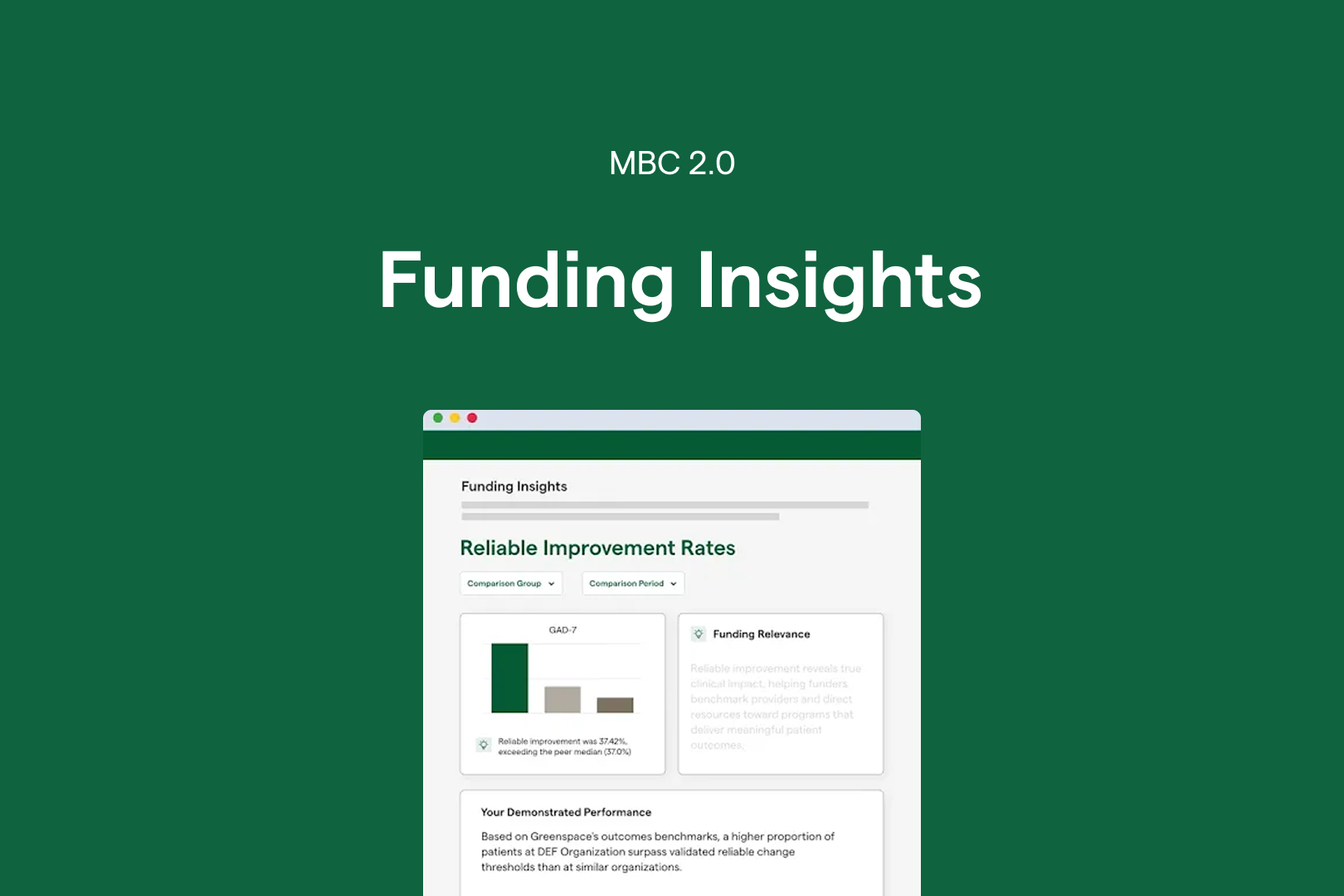
Across the mental health landscape, funders from government bodies to private foundations are increasingly tying grants and contracts to demonstrable outcomes. RFPs are screening for outcome measurement capabilities and funding applications are requesting data on client improvement. Without the infrastructure to collect and report that data, organizations are at a disadvantage in what has become an increasingly competitive landscape.
MBC provides the infrastructure needed to implement routine measurement and demonstrate those outcomes. Organizations with a consistent, systematic approach to measuring outcomes are better positioned to compete for funding and demonstrate continued impact to retain it.
2. Accreditation Standards Are Evolving
Accreditation bodies are raising the bar on quality measurement. Organizations seeking or renewing accreditation are increasingly expected to have an established process for measuring outcomes, improving care, and iterating on services and programming.
When MBC is implemented well, it gives organizations the data they need to meet these requirements: standardized assessments, consistent collection practices, and the ability to track progress across individual clients and entire populations.
3. CMS Is Tying Payment to Outcomes
In May 2026, CMS announced the ACCESS model, a new payment framework that ties reimbursement to demonstrated clinical improvement rather than billing activity. Mental health, specifically depression and anxiety, is one of the model’s four initial tracks.
Under ACCESS, organizations receive payment based on whether clients actually improve, measured against standardized clinical and patient-reported outcome measures submitted through FHIR-based interfaces. This is a fundamental shift in how mental health care gets paid for. It also signals that establishing infrastructure to collect, track, and report on outcomes is essential to participating in new and innovative funding streams as they will continue to appear in the coming months and years.
4. Value-Based Care Is Making Outcomes the Currency of Care
Across healthcare, the shift toward value-based contracting is accelerating. Payers and health systems are moving away from fee-for-service and toward models that reward quality and efficiency. In mental health, this trend has historically lagged behind other clinical settings, but that gap is closing. Organizations that can demonstrate outcomes reliably, consistently, and at scale are better positioned to participate in value-based contracts and prove their worth within integrated care systems.
Ready to See MBC in Action?
Get a personalized walkthrough to see how Measurement-Based Care can be implemented at your organization.
Schedule a CallMBC is a Long-Term Organizational Strategy.
This is perhaps the most important shift in how mental health leaders are thinking about MBC, and it’s one we hear consistently from the organizations we work with. While at it’s core, MBC is about what happens in the therapy room, when implemented meaningfully it works to address multiple organizational priorities at once:
- Care quality: MBC helps clinicians know whether treatment is working and adjust when it isn’t. Research shows that clients whose providers use MBC experience significantly better outcomes, are more likely to experience reliable change, and are more engaged in their care.
- Funding: Outcome data strengthens grant applications, satisfies funder reporting requirements, and positions organizations to succeed in an increasingly competitive funding environment.
- Accreditation: Systematic measurement practices demonstrate care quality to accreditation bodies and support continuous quality improvement.
- Payment reform: As models like ACCESS expand, organizations with MBC infrastructure are ready to participate. Those without it face a steeper climb.
- Early intervention: Population-level outcome data helps organizations identify at-risk clients earlier, allocate resources more effectively, and prevent deterioration before it escalates.
When you implement MBC well, you’re not just improving care for individual clients. You’re building the data infrastructure that supports your organization’s sustainability and growth.
What Does Effective MBC Actually Look Like?
MBC done well means:
- Consistent, automated assessment delivery so that outcome data is collected reliably across every client, every session, without adding burden to providers or clients
- Standardized measures that are evidence-based, validated, and appropriate to your population
- Real-time data visualization that makes findings actionable for individual providers at the session level and for clinical leaders at the organizational level
- Population-level insights that surface trends, flag at-risk clients, and enable proactive intervention
- Seamless integration into existing workflows and EHR/EMR systems so that measurement enhances care rather than interrupting it
The difference between MBC that transforms an organization and MBC that simply becomes an additional administrative task comes down to implementation: the workflow design, the clinician training, and the ongoing support.
That’s why we partner with organizations to support them through every step of implementation, training, and beyond.
The Time for MBC Is Now
G2’s decision to create a dedicated MBC category in their 2026 rankings is a small signal of a much larger shift. The field is catching up, the system is demanding it, and the organizations building MBC infrastructure today are the ones that will be best positioned for what mental health looks like in the years ahead.
Whether your organization is just beginning to explore MBC or looking to strengthen an existing program, the momentum is clear and the time to act is now.
See Why Greenspace Was Recognized as the Best Platform for Measurement-Based Care
Read G2’s full 2026 Mental Health Software Rankings to learn more about the evaluation and why Greenspace was recognized as the leading platform for Measurement-Based Care and Outcomes Tracking.
Ready to See Measurement-Based Care in Action?
Whether you’re exploring MBC for the first time or looking to scale an existing measurement strategy, Greenspace can help.