In behavioral health care, progress isn’t always linear. Many people transition to different levels of care as they progress or regress, and return to care at different points in their lives; when stressors resurface, when circumstances change, or when they’re ready to focus on new goals.
Research and implementation evidence consistently show that mental health recovery often involves multiple treatment episodes over time, especially for those with serious mental illnesses. Approximately 30–50% of people accessing behavioral health treatment will re-engage with care after completing an initial course of treatment, whether due to relapse, new challenges, or to explore continued personal growth (1,2,3).
For clinicians and clinical leaders, returning clients or those transitioning to a new level of care represent both an opportunity and a challenge: each new episode of care is a valuable chance to build on what’s already been learned but, without a clear view of an individual’s prior care experiences and outcomes, the process can feel like starting over. Too often, returning clients must retell their stories, histories, or repeat assessments that have been previously administered. This not only slows down clinical progress, it can also be emotionally taxing for clients who are eager to move forward with their treatment, rather than revisit the past.
Continuity is at the heart of meaningful care, which is why Greenspace offers partner clinics our Multiple Episodes of Care feature: an easy to use but transformative tool that ensures no client’s story ever gets lost between chapters.
Why It Matters
Every client’s care journey is unique, but most systems are still built around single episodes of treatment. When a client returns to care, clinicians often need to create a new profile, manually re-enter data, or track down notes and assessments from previous episodes.
In many cases, clinicians will not have the ability to access a client’s past episodes of care if they weren’t the treating clinician. This approach makes it difficult to develop a holistic view of a client’s experiences, including historical progress, what positively or negatively impacted them throughout care, and other key information which would help to inform and improve their treatment decisions, discussions, and process for the future.
Beyond the workflow inefficiencies, this fragmentation can disrupt the therapeutic process. Clients who have already built trust with a clinician shouldn’t have to reintroduce themselves or recount painful experiences to provide context. Their data and their story should follow them throughout their journey.
By enabling providers to see a full history of a client’s engagement and outcomes, we help ensure that each new episode builds upon the last, strengthening continuity and enabling more personalized, data-informed, high-quality care.
Connecting Multiple Episodes of Care
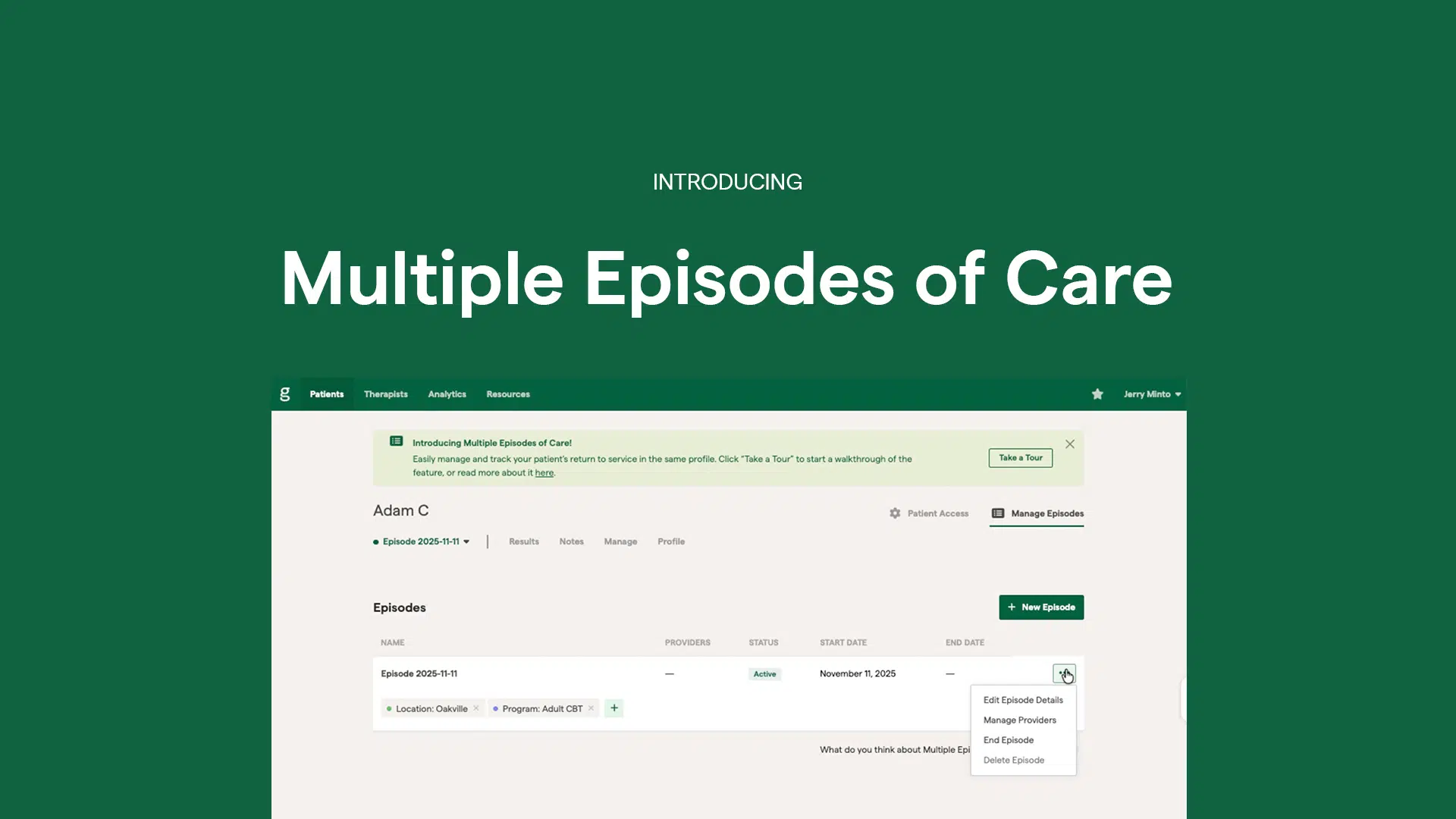
The Multiple Episodes of Care feature allows organizations and clinicians to manage returning clients with a more efficient, impactful, and personalized approach. Clinicians, clinical leaders and admins can now create, view, and manage multiple episodes of care under a single client profile, no duplication, no lost data, no re-entry.
Each episode is stored within the same client profile, making it easy to understand a client’s past experiences, what interventions or programs they’ve engaged with, and how their symptoms and functioning have changed over time. With all episodes in one place, clinical teams gain an accurate, longitudinal view of progress and patterns, helping to inform better care decisions throughout all episodes of treatment.
Of course, none of this ever comes at the expense of data privacy and security. Previous episodes are not accessible to any new providers unless clients consent to sharing it, and as always, no one outside the client care team will have access to their assessment results.
The Impact: Building True Continuity in Care
For clinicians, this means less time spent searching through records or asking clients to reshare their experiences, and more time focusing on meaningful treatment. For admins, it means cleaner data and a clear record of each client’s engagement across programs. And for clients, it means a smoother, more compassionate return to care, one that acknowledges where they’ve been and better supports where they’re headed next.
The ability to manage multiple episodes of care in one place brings us closer to a more connected model of behavioral health that reflects the reality of what clients and their clinicians know well: healing and recovery often happens in stages, and that progress is built over time. To learn more about Measurement-Based Care with Greenspace or our Multiple Episodes of Care feature, book a call with our implementation expert or reach out anytime at info@greenspacehealth.com.
References
- Zeber, J. E., Coleman, K. J., Fischer, H., Yoon, T. K., Ahmedani, B. K., Beck, A., Hubley, S., Imel, Z. E., Rossom, R. C., Shortreed, S. M., Stewart, C., Waitzfelder, B. E., & Simon, G. E. (2017). The impact of race and ethnicity on rates of return to psychotherapy for depression. Depression and anxiety, 34(12), 1157–1163. https://doi.org/10.1002/da.22696
- Lorimer, B., Kellett, S., Giesemann, J., Lutz, W., & Delgadillo, J. (2023). An investigation of treatment return after psychological therapy for depression and anxiety. Behavioural and Cognitive Psychotherapy. https://doi.org/10.1017/S1352465823000322
- Kilcullen, R. (2020, November 11). Returning therapy clients: Determining prevalence rates and identifying predictive variables. Center for Collegiate Mental Health. https://ccmh.psu.edu/index.php?option=com_dailyplanetblog&view=entry&category=new-findings&id=6%3Areturning-therapy-clients-determining-prevalence-rates-and-identifying-predictive-variables